I Analyzed 217,000 European Job Listings — Here's What I Found
By Marco · February 6, 2026 · 7 min read
I'm building AlmostHired, an AI-powered job matching tool for the European market. As a side effect, I ended up with a database of 217,000+ job listings across major cities in 15 countries.
I decided to look at the data. What I found surprised me.
Europe's Job Market Is Not What You Think
If you're looking for a job in Europe, you're probably browsing LinkedIn and Indeed, filtering by country, scrolling endlessly. But where are the actual jobs?
Here's the breakdown:
- UK — 51,751 jobs
- France — 47,631 jobs
- Germany — 45,395 jobs
- Netherlands — 17,803 jobs
- Italy — 11,631 jobs
- Spain — 11,171 jobs
- Belgium — 5,611 jobs
- Ireland — 5,533 jobs
- Switzerland — 4,981 jobs
- Sweden — 4,257 jobs
- Austria — 3,492 jobs
- Portugal — 3,259 jobs
- Denmark — 2,006 jobs
- Luxembourg — 2,000 jobs
- Norway — 870 jobs
The UK, France, and Germany alone account for 66% of all open positions. If you're flexible about where you work, that's where the odds are in your favor.
The Nordics (Sweden, Denmark, Norway) look attractive on paper — great salaries, work-life balance — but the actual volume of open positions is relatively small. Competition for each role is fierce.
The Most In-Demand Jobs Are Not What You'd Expect
Here's what surprised me: the most posted job titles aren't "Software Engineer" or "Data Scientist." Here are the top 15 across all 15 countries:
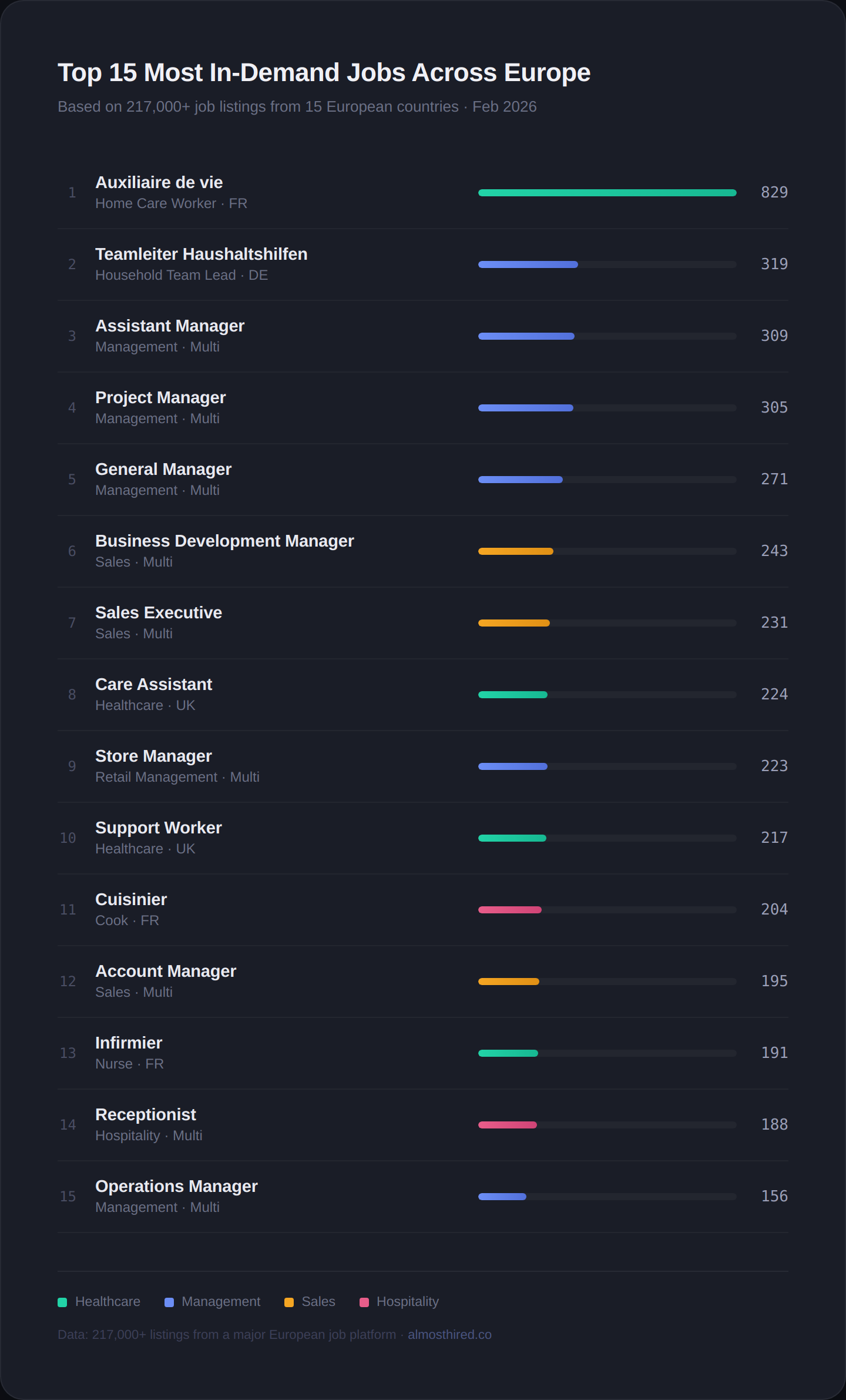
Healthcare takes the #1 spot. The most-posted role is "Auxiliaire de vie" (home care worker) with 829 listings combined — 360 regular positions and 469 apprenticeships. Care assistants, nurses, and support workers all appear in the top 15 as well.
Management titles are everywhere. Five of the top 15 titles are management roles: Assistant Manager, Project Manager, General Manager, Store Manager, and Operations Manager. Whatever the industry — if you can manage people, Europe has a role for you.
Tech titles are fragmented, not absent. "Software Engineer" sits at #23 with 123 listings — but that doesn't mean tech demand is low. It's spread across dozens of specialized titles: Data Engineer (104), Senior Software Engineer (100), DevOps Engineer (54), Full Stack Developer (53), AI Engineer (37), and many more. The same role has a different title at every company. A cook is a cook — but a developer can be a Software Engineer, Backend Developer, Full Stack Engineer, or Python Developer depending on who's hiring.
Europe's Job Market Speaks Five Languages
This was the most surprising finding. In my database, job titles appear in English, French, German, Dutch, and Italian — sometimes within the same country.
Look at the top titles again: "Auxiliaire de vie" and "Cuisinier" are French. "Teamleiter Haushaltshilfen" and "Pflegefachkraft" are German. "Verkoopmedewerker" is Dutch. "Cuoco" is Italian. They sit right next to English titles like "Assistant Manager" and "Sales Executive."
This has a practical consequence: if you search for jobs in only one language, you miss a huge chunk of the market. A French-speaking nurse searching for "nurse" won't find "Infirmier" listings. A German speaker looking for "Verkäufer" won't see "Sales Associate" roles in the same city.
Most job platforms silo you into one language. The European job market doesn't work that way.
Country-by-Country Highlights
France is hiring massively in healthcare and hospitality. Care workers and cooks are the top roles — and almost everything is posted in French.
Germany mixes German and English job titles. You'll find "Außendienstmitarbeiter" next to "Project Manager." Speaking German is almost mandatory for the highest-volume positions.
The Netherlands punches above its weight with 17,800 listings for a country of 17 million. Job titles appear in both Dutch and English.
Switzerland — small but premium. 4,981 positions, but with some of the highest salaries in Europe. A competitive market where language skills (German, French, or Italian depending on region) are key.
Luxembourg — tiny (2,000 listings) but unique. One of the most multilingual job markets in Europe. French, German, and English are commonly required. If you speak all three, you have a serious advantage.
What This Means For Your Job Search
1. Go where the jobs are. UK, France, and Germany have the volume. Don't limit yourself to one country if you're flexible.
2. Search in multiple languages. This is the single most overlooked strategy. If you speak French and English, search in both. You'll find opportunities that monolingual job seekers miss entirely.
3. Management experience transfers. Management titles dominate across every country and industry. If you've managed teams, your skills are in demand everywhere.
4. Healthcare demand is real. Care workers, nurses, and medical staff appear consistently across countries. Europe's aging population is driving this, and it's not slowing down.
5. Stop scrolling. With 217,000 listings across 15 countries in at least 5 languages, manually browsing is insane. That's exactly why I built AlmostHired — upload your CV once, get matched against all of them, and see exactly why you fit (or what you're missing).
This analysis is based on 217,000+ job listings aggregated from major European job sources, covering major cities and metropolitan areas across 15 countries. Rural areas and smaller cities are not fully represented in this data.